News & Blog
Great things in business are never done by one person. They’re done by a team of people. We have that dynamic group of peoples

Pad printing can help cosmetic brands place logos, symbols, and small graphics on curved caps, pump components, and other areas that are difficult to decorate. Its flexible silicone pad transfers ink from an engraved plate onto the component, adapting to the surface during contact. However, a curved shape alone does not make a project suitable for pad printing. The material, surface finish, artwork, component support, and durability requirements all matter. This guide explains where pad printing fits within cosmetic packaging decoration, how to compare it with other methods, and what buyers should confirm before approving samples and production.
Pad printing, also called tampo printing or tampography, is an indirect printing process. An etched plate, known as a cliché, holds the image. Ink fills the recessed artwork, and excess ink is removed from the surrounding plate surface. A silicone pad picks up the image and transfers it onto the part. The pad carries the ink temporarily; it does not act like an absorbent sponge. Inkcups’ process guide explains these core components.
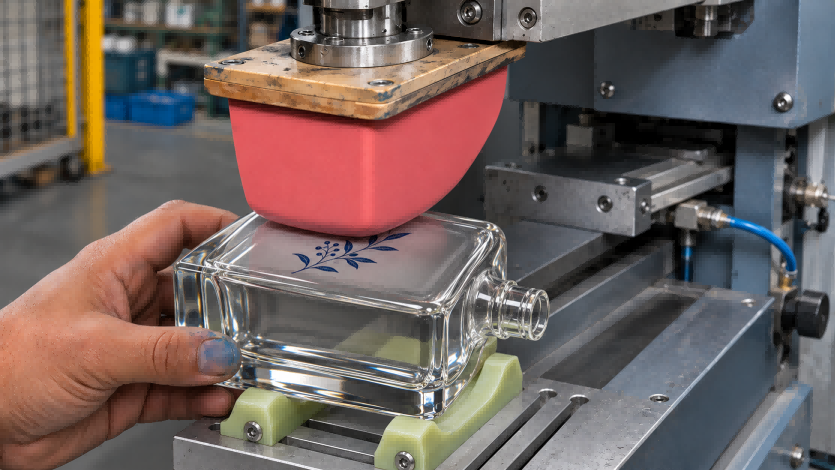
Before printing, the part sits in a fixture that supports it and establishes its position. After transfer, the ink must dry or cure according to the selected system. Multicolor designs require controlled alignment between colors, commonly called registration.
For buyers, the practical implication is that artwork approval and process approval are different decisions. A digital proof confirms the design, but a decorated sample confirms how that design transfers onto the actual component. Request both, especially when the print crosses a changing curve or sits close to an edge.
Pad printing is worth evaluating when the decoration is localized and the surface is curved, compact, or awkward to access. Potential applications include a logo on a pump actuator, a symbol on a cap, or a small graphic on a contoured bottle. Glass is also a possible substrate when the ink system and preparation suit the surface, as illustrated by Unique Assembly & Decorating’s glass printing applications.
Access still has limits. A pad must reach the intended area without colliding with surrounding features, and the component must withstand contact without moving or deforming excessively. A recessed logo area surrounded by a raised rim may need a different approach from an exposed curved face.
Consider an illustrative skincare set with a glass bottle and a rounded plastic cap. The bottle’s main branding and the cap’s small emblem need not use the same decoration method. Assess each surface separately, then approve their appearance together. This avoids forcing one process onto every component merely to keep the purchase specification simple.
Choose a process by the required appearance and print area, rather than by the bottle material alone. Pad printing is a candidate for compact graphics on complex shapes. Screen printing may be a better starting point for larger graphics on accessible bottle walls, while hot foil stamping deserves consideration when reflective foil is central to the design. None of these choices is automatic: tooling, surface condition, and geometry determine feasibility.
The table below is a project review framework, not a universal price or performance ranking. Ask the decorator to explain the proposed route using your actual drawing and artwork. A convincing recommendation should identify both the suitable areas and the features that need sampling.
| Buyer requirement | Method to evaluate first | What to confirm |
|---|---|---|
| Small logo on a curved cap or pump component | Pad printing | Pad access, support, distortion, and adhesion |
| Larger branding on an accessible bottle wall | Screen printing | Printable area, bottle geometry, opacity, and registration |
| Reflective metallic logo or band | Hot foil stamping | Foil compatibility, contact geometry, and substrate suitability |
| Small graphic on a contoured glass surface | Pad printing | Surface preparation, ink system, and curing conditions |
| Several decoration effects across a coordinated set | A combination of processes | Color harmony, production sequence, and approval samples |
A metallic ink should not be approved from a photograph of a foil finish. Likewise, a small printed emblem does not demonstrate that a large solid panel will reproduce equally well. Compare physical samples that represent the effect, coverage, and surface you intend to buy.
Pad shape, size, and hardness influence how the image reaches the component. Softer is not always better for fine detail. Inkcups’ pad selection guidance distinguishes applications for harder pads, including textured or stepped surfaces, from contoured or fragile parts that may benefit from softer pads. Selection therefore needs to consider the whole application rather than a single hardness number.
For procurement purposes, approve the result and ask the decorator to record the setup used to achieve it. Useful records include pad identification, fixture identification, artwork revision, and reference samples. These provide a basis for investigating a later change in print quality without requiring buyers to prescribe machine settings themselves.
Contact pressure should also be established through trials. If a sample shows a stretched circle or uneven lettering, increasing pressure without diagnosing the cause may worsen the result. Ask whether the pad contacts the surface predictably and whether the fixture supports the part at the point of contact. A clear sample produced with a documented setup is more valuable than an unsupported promise about machine precision.
Specify the surface that receives the ink, not only the material underneath. A clear glass bottle, a sprayed glass bottle, and a bottle with a separate topcoat present different interfaces to the print. The same logic applies to molded plastic, painted plastic, and coated metal. Record the finish on the drawing and provide representative components for trials.
Ink adjustments are system-specific. Marabu’s technical guidance explains that viscosity and thinner selection affect transfer, edge definition, drying, and adhesion. A fixed ink-to-thinner ratio should therefore not be treated as a recipe for every project. The decorator should follow the selected ink’s technical instructions, including any hardener, processing window, and curing requirements.
Request confirmation of the ink series and the surface used for qualification. If either changes before production, agree whether another approval is needed. Descriptions such as “UV ink” or “water-based ink” are not substitutes for performance evidence on your package. Keep environmental or market-specific compliance claims separate from visual approval, and request documentation relevant to the actual product and intended destination.
Start with artwork at its intended printed size. A logo that looks clear on a large monitor may become difficult to read when reduced to fit a cap. Send an editable vector file where available, identify each color, and show the print dimensions in millimeters. Ask the decorator to flag fine lines, tight letter spacing, or large filled areas that need a trial.
Define location from a stable physical reference. “Centered on the cap” can be ambiguous when the cap has an irregular outline or an asymmetric top. A drawing should identify the viewing direction, orientation, and reference features used for inspection. Where a logo must align with another component, review the complete assembly rather than judging each part independently.
Treat color approval as a physical comparison. Specify the target reference and agree how finished samples will be assessed, including lighting and background. On transparent packaging, the appearance may change when viewed empty or filled. If numerical color tolerances are required, define the measurement method and conditions together; a tolerance without those details leaves room for different interpretations.
A sample can look acceptable before it has reached the ink system’s required cure. Agree when durability testing will take place and record the conditioning time. Approval should cover appearance, print position, and resistance to the exposures expected in use, rather than relying on one quick scratch check.
For a perfume package, a buyer may need to assess accidental contact with the intended fragrance. For skincare packaging, handling with product residue may be relevant. These are proposed project considerations, not universal test prescriptions. Ask your technical team and decorator to define a suitable test liquid, contact time, rubbing medium, applied load, and evaluation criteria.
An instruction such as “must pass an alcohol test” is incomplete. A brief wipe and a prolonged exposure do not answer the same question. Similarly, a stated number of rubs means little unless the procedure is reproducible. Keep the agreed protocol with the sample approval record so repeat orders can be evaluated consistently.
Set separate requirements for missing print, blurred edges, visible misalignment, color variation, and damage after testing. Where an adhesion method is specified, confirm its suitability for the size and curvature of the decorated area. Do not assume a test designed around an accessible flat coating can be applied unchanged to a tiny curved logo.
Retain approved reference samples with their revision and approval date. Include the final component finish, not a convenient substitute. An undecorated sample, a digital proof, and a decorated production reference serve different purposes and should be clearly identified.
A defect does not automatically mean pad printing is the wrong process. Ink selection, contamination, preparation, machine stability, and consumable condition can all affect results. Inkcups’ troubleshooting guide identifies these as practical investigation areas. The table translates them into buyer questions; it is a starting point for investigation rather than a definitive diagnosis.
| Observed issue | Possible area to investigate | Buyer’s next step |
|---|---|---|
| Print lifts or rubs away | Ink compatibility, preparation, or cure | Request the ink identification, surface details, and test timing |
| Logo looks stretched | Pad contact or component support | Compare the print with the approved artwork and review the fixture |
| Double edges appear | Movement or vibration | Request a production review and samples after correction |
| Parts of the image are missing | Transfer, plate condition, or contamination | Ask the decorator to isolate where the image becomes incomplete |
| Quality changes during a run | Consumable condition or ink handling | Compare samples from different production stages and process records |
Avoid approving a correction solely because one replacement sample looks better. Ask what changed and whether the adjustment will be used throughout the order. If the correction alters the artwork, color, or print position, issue a revised approval so production and inspection use the same reference.
For example, if only the outer letters of a curved logo become distorted, first clarify whether the problem is repeatable at that location. The answer helps distinguish a design-area limitation from intermittent movement. This is an investigation approach, not evidence of a particular factory’s performance.
A useful quotation starts with enough information to assess feasibility. Share the component drawing or clear photographs, dimensions, substrate, surface finish, print location, artwork size, number of colors, and required quantities by design. Include the intended product category and any defined durability requirements. If the package has not been finalized, identify which details are provisional.
Ask the supplier to separate one-time preparation from recurring production charges. Depending on the project, quotation items may include plates, fixtures, color matching, sampling, pretreatment, printing, curing, inspection, and protective packing. These are items to clarify, not a claim that every order requires every charge. Compare quotations against the same scope before deciding which offers better value.
Build an approval sequence into the schedule: technical review, artwork confirmation, decorated samples, agreed testing, and production approval. Identify who can approve changes and how revisions will be recorded. When components come from different sources, assign responsibility for providing representative samples and communicating finish changes. This reduces uncertainty about whether the approved decoration matches the parts that will actually arrive for printing.
Yes, it can be considered for glass bottles, especially localized graphics on contoured areas. Approval should relate to the actual glass surface or coating, the selected ink, and its curing process. A successful print on one bottle finish does not qualify a different finish automatically. Request decorated samples of the intended component.
It depends on the print area and design. Pad printing is worth reviewing for compact graphics and difficult contours; screen printing is another option for accessible bottle surfaces. Compare both against your artwork, coverage, color requirements, and production scope. A package may use different methods on its bottle and closure.
It may be possible, but feasibility needs a sample review. Each color must align with the others on the finished component. Ask for artwork at actual size and inspect the boundaries between colors. If the design proves difficult to reproduce consistently, discuss simplifying the graphic or adjusting its location before production approval.
Request the final artwork revision, decorated samples on representative components, an agreed inspection specification, and relevant test results. Confirm that the sample finish and material match the production order. Also record how later changes to artwork, components, or decoration will be communicated and whether they require renewed approval.
There is no single test description that answers every packaging use case. Start with the exposure you need to evaluate and agree a complete procedure. Define the liquid, duration, rubbing conditions where applicable, cure time, and acceptance criteria. Ask the responsible technical team to select an appropriate method for your project.
Since 2004, YAFENG Packaging has focused on custom cosmetic glass packaging. Decoration planning starts with the bottle, its components, and the finish your brand needs. For a project review, contact YAFENG Packaging with your bottle format, component material, artwork, print location, target quantity, and launch schedule so the team can discuss suitable next steps with you.



Discover the sustainable revolution in beauty packaging! Learn how bamboo is transforming the cosmetic industry with its eco-friendly, durable, & stylish appeal.
Glass bottles are the best for hair oil storage due to their non-reactivity, UV protection, and ability to preserve quality, ensuring longer shelf life and better efficacy.
Discover the electrostatic flocking process in packaging, enhancing cosmetic glass bottles with luxurious textures, vibrant colors, and eco-friendly designs for premium products.

Elevate your packaging game with glass packaging material. Learn how to achieve a matte look with our informative guide.
Learn about common glass container defects in cosmetic packaging, their causes, and solutions. Ensure quality and safety for your products with expert insights.
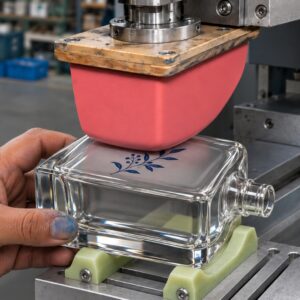
Explore laser marking for cosmetic packaging, compare glass and plastic options, and learn which sample checks to complete before approving production.
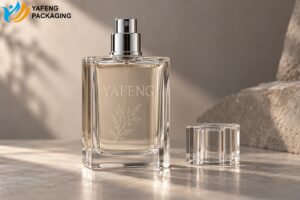
Explore laser marking for cosmetic packaging, compare glass and plastic options, and learn which sample checks to complete before approving production.

A factory-insider walkthrough of how glass perfume bottles are made — from raw materials and 1500°C melting to molding, annealing, decoration, QC, and packing.
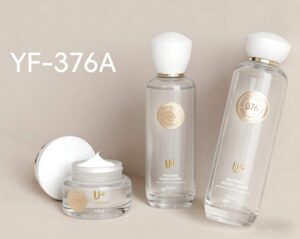
Why most hot-stamped perfume bottles fail alcohol tests — and how UV hot stamping and PVD vacuum coating solve it. Material guide for fragrance brands.
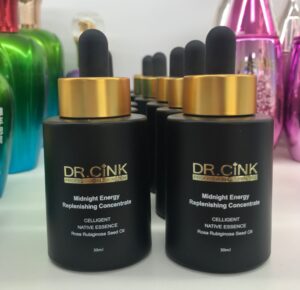
Explore screen printing and hot stamping for cosmetic glass bottles, including processes, defects, cost comparison, and tips for choosing reliable manufacturers.
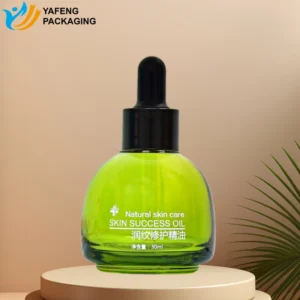
Discover how spray coating enhances skincare and perfume packaging by improving appearance, brand identity, durability, and safety with advanced technology.