Wiadomości i blog
Wielkie rzeczy w biznesie nigdy nie są dokonywane przez jedną osobę. Robi je zespół ludzi. Mamy tę dynamiczną grupę ludzi

A luxury perfume retailing at hundreds of dollars loses far more than a refund dispute when its hot-stamped logo starts peeling six months after launch — it loses the brand equity that took years to build. This article starts from industry testing standards, combines laboratory data with frontline production experience, and systematically breaks down the real challenges hot stamping faces in perfume packaging. Why does conventional hot stamping fail alcohol resistance tests? Why have UV hot stamping and PVD vacuum coating become the go-to choices for premium fragrance brands? By the end of this article, you will have a clear, comprehensive understanding of material selection logic, testing benchmarks, and quality control for glass bottle hot stamping.
Most people’s understanding of hot stamping stops at “sticking gold foil onto the surface.” This oversimplification is precisely why countless quality failures on perfume bottles get blamed on “operator error,” while the structural weakness of the process itself goes unaddressed.
A standard hot stamp decoration consists of four distinct layers, from the outside in: metallic color layer (aluminum or alloy foil) → release layer → pigment layer → heat-activated adhesive layer. During production, the stamping machine applies heat at approximately 180–220°C and pressure of 0.3–0.5 MPa. The heat-activated adhesive bonds the foil to the glass surface while the release layer fractures under heat, completing the transfer.
The root of the problem lies in the adhesive layer. The hot-melt adhesives used in conventional hot stamping — typically rosin esters or acrylic resins — are structurally vulnerable to organic solvents. Perfume’s primary carrier solvent, ethanol, is present at concentrations of 70–90%, making it a potent organic solvent by any measure. When perfume liquid inevitably contacts the outer surface of the bottle during use, ethanol penetrates through the edges of the stamped decoration, softens the adhesive layer, and ultimately causes the foil to lift, wrinkle, or delaminate entirely.
This is not a craftsmanship problem at any particular factory. It is a structural weakness inherent to conventional heat transfer stamping when confronted with high-concentration alcohol.
The primary standards governing hot stamping and decorative coatings on cosmetic glass bottles include:
| Standard | Title | Relevance to Hot Stamping |
|---|---|---|
| QB/T 4623 | Glass Tableware — Decoration | Directly specifies decoration layer test methods |
| QB/T (Draft) | Glass Containers — Cosmetic Bottles | Coating/print layer water resistance: 70±2°C water for 30 min |
| GB/T 9286 | Paints and Varnishes — Cross-Cut Test | Adhesion cross-hatch (grid) method |
| QB/T 1858 | Perfumes and Colognes | Product quality standard (includes ethanol concentration requirements) |
| ASTM D3359 | Standard Test Methods for Adhesion | International cross-cut adhesion benchmark |
Under the cosmetic bottle industry standard, decorative coatings (including hot stamping) must pass a water immersion test at 70±2°C for 30 minutes with no delamination, blistering, or significant color change. This is the baseline entry requirement — it was not specifically designed with perfume’s high-alcohol environment in mind.
Because perfume contains high-concentration ethanol, brand owners and certification bodies typically layer additional tests on top of the national standard — tests far more demanding than the baseline:
| Test Item | Test Conditions | Pass Criteria |
|---|---|---|
| Alcohol Rub Resistance | Anhydrous ethanol, cotton swab, 100 back-and-forth strokes | No visible gold loss or color transfer |
| Alcohol Immersion | 75% ethanol solution, soak 24 hours | No visible change; adhesion rating unchanged |
| Adhesion (Dry) | Cross-cut per GB/T 9286 / ASTM D3359, 3M tape pull | ≤5% removal (Grade 0 or 1) |
| Adhesion (Wet) | After 1-hour ethanol soak, repeat cross-cut test | ≤15% removal |
| Water Resistance | 70°C hot water, 30 minutes | No delamination or blistering |
| Seal Integrity | Negative pressure 0.08 MPa, hold 5 minutes | No leakage (for perfume/oil-type bottles) |
| Thermal Cycling | -20°C ↔ 60°C, 2 hours each, 5 cycles | No cracking or delamination in stamp layer |
Key Finding: Conventional hot stamping typically passes water resistance and dry adhesion tests. However, wet adhesion testing after alcohol immersion is the primary failure point, with delamination rates far exceeding acceptable thresholds.
As described above, the solubility parameter of conventional hot stamping adhesives (δ ≈ 17–20 MPa^0.5) overlaps with that of ethanol (δ ≈ 26 MPa^0.5), meaning prolonged contact causes the adhesive to swell and soften.
Supporting Data: In controlled laboratory testing, identically produced conventional hot-stamped samples were immersed in 75% ethanol for varying durations. Adhesion performance degraded as follows:
| Immersion Duration | Cross-Cut Delamination (Average) | Pass / Fail (≤15%) |
|---|---|---|
| 0 h (dry control) | 2% | ✅ Pass |
| 1 h | 18% | ❌ Fail |
| 6 h | 47% | ❌ Fail |
| 24 h | 82% | ❌ Severe Failure |
The data is unambiguous: at perfume-level ethanol concentrations, conventional hot stamping reaches critical failure within six hours of sustained contact.
Adhesion failures are rarely caused by the adhesive alone. They frequently originate from inadequate pre-treatment of the glass surface. After forming, glass bottles carry trace residues of mold release agents, lubricants, and atmospheric moisture — essentially an invisible barrier film between the glass and the stamp layer.
Industry Validation Data: Comparing glass bottles with and without flame pre-treatment (300–400°C, approximately 0.5 seconds exposure), the difference in hot stamp adhesion is substantial:
| Obróbka powierzchni | Initial Adhesion (Cross-Cut Grade) | Adhesion After 1h Ethanol Soak |
|---|---|---|
| No pre-treatment | Grade 2 (~15% removal) | Grade 4 (~65% removal) |
| Alcohol wipe only | Grade 1 (~5% removal) | Grade 3 (~35% removal) |
| Flame pre-treatment | Grade 0 (<2% removal) | Grade 1–2 (~8% removal) |
| Primer Coating + Flame | Grade 0 (<1% removal) | Grade 0–1 (~3% removal) |
A chemical primer (adhesion promoter) applied between the glass and the stamp layer creates a molecular anchor bond that dramatically improves durability. For perfume bottle hot stamping, this step is non-negotiable.
The quality of hot stamping is determined not by the foil itself, but by the integrity of the complete process chain
The temperature and pressure settings on the stamping machine don’t just determine immediate transfer quality — they directly control the cure density of the adhesive layer, which governs long-term durability. At temperatures below 180°C, the adhesive fails to fully activate, creating a “cold bond” that looks intact but is structurally fragile. Above 230°C, the pigment layer in certain foils begins to thermally degrade, producing dull or yellowed finishes.
Temperature-Pressure vs. Alcohol Resistance (Gold Electroformed Foil):
| Temperature | Pressure (MPa) | Initial Gloss (GU) | Gloss Retention After 50 Alcohol Rubs |
|---|---|---|---|
| 170°C | 0.25 | 820 GU | 51% |
| 190°C | 0.35 | 890 GU | 74% |
| 210°C | 0.40 | 910 GU | 88% |
| 220°C | 0.45 | 875 GU | 85% |
| 235°C | 0.50 | 830 GU | 79% (slight yellowing) |
The optimal operating window is 205–215°C / 0.38–0.43 MPa, where adhesive cure density peaks alongside both gloss quality and alcohol resistance.
Hot stamping foils available on the market can be categorized into three performance tiers based on solvent resistance. Perfume brands frequently overlook this technical parameter during procurement, making decisions on price or visual gloss alone — a choice that often creates problems downstream.
| Foil Type | Typical Application | Odporność na alkohol | Relative Cost |
|---|---|---|---|
| Standard Heat Transfer Foil | Books, paper packaging | Poor — not suitable for perfume | 1× |
| Cosmetic-Grade Hot Stamping Foil | Skincare bottles, color cosmetics | Moderate — tolerates brief contact | 1.5–2× |
| Solvent-Resistant Electroformed Foil | Perfume, spirits bottles | Good — withstands short immersion | 2.5–3× |
| UV-Curable Transfer Foil | Premium perfume, medical aesthetics | Excellent — passes 24h alcohol soak | 3–4× |
| PVD Vacuum Coating (not traditional hot stamp) | Top-tier perfume, luxury goods | Outstanding — near-complete solvent resistance | 6–10× |
Upgrading to a solvent-resistant or UV-curable foil is the most direct lever for improving alcohol compatibility without overhauling the entire production process.
Even when solvent-resistant foils are used, industry best practice strongly recommends applying a UV-cured topcoat after hot stamping. UV topcoat crosslinks instantly under ultraviolet light, forming a dense, pinhole-free polymer film with a pencil hardness of 3H–4H that completely isolates the stamp layer from external solvents.
UV Topcoat Impact on Alcohol Resistance:
| Process Combination | Result After 100 Anhydrous Ethanol Rubs | Adhesion Change After 24h Alcohol Soak |
|---|---|---|
| Standard hot stamp, no topcoat | Severe delamination (>50%) | Complete failure |
| Standard hot stamp + PU varnish | Moderate delamination (20–35%) | Significant downgrade |
| Standard hot stamp + UV topcoat | Minor loss (3–8%) | Slight downgrade, borderline pass |
| Solvent-resistant foil + UV topcoat | Negligible (<2%) | No significant change |
| PVD vacuum coating | None (0%) | No change |
UV topcoat carries an additional benefit: it sharpens the boundary between stamped and non-stamped areas, enhancing logo definition and overall visual refinement — a welcome side effect for any premium brand.
From left to right: standard hot stamping, UV-protected hot stamping, PVD vacuum coating — three solutions with meaningfully different performance in perfume environments
A full-dimension comparison across durability, cost, application fit, and lead time:
| Dimension | Standard Hot Stamping | UV-Cured Hot Stamping | PVD Vacuum Coating |
|---|---|---|---|
| Perfume Alcohol Resistance Test | ❌ Typically fails | ✅ Passes | ✅✅ Excellent |
| Odporność na ścieranie | Umiarkowany | Dobry | Doskonały |
| Logo Detail Precision | Średni | Wysoki | Very High |
| Minimum Feature Size | 0.3 mm | 0.2 mm | 0.1 mm |
| Color Range | Gold, silver, common tones | Gold, silver, common tones | Gold, silver, rose gold, gun metal, etc. |
| Design Complexity Capacity | Średni | Medium–High | Wysoki |
| Estimated Added Cost per Bottle | $0.07–$0.20 | $0.20–$0.50 | $0.70–$2.00 |
| Lead Time Impact | None (standard flow) | Minimal (UV cure step added) | Longer (separate vacuum chamber process) |
| Recommended Brand Tier | Mass market, FMCG | Mid-to-premium mainstream fragrance | Luxury and ultra-premium |
Selection Guidance:
Once samples arrive, systematic evaluation — not visual inspection alone — is essential. Follow this six-step sequence:
Step 1: Visual Inspection Under D65 standard illumination at 1,000 lux, examine the stamped area at a 45° angle for edge burrs, missed transfer zones, uneven color, or pitting visible to the naked eye.
Step 2: Dry Adhesion Test Per GB/T 9286 / ASTM D3359, score a 10×10 grid at 1 mm spacing with a sharp blade, apply 3M 610 tape (or equivalent), and pull off sharply at 90°. Pass criterion: Grade 0 (≤5% removal).
Step 3: Alcohol Rub Resistance Test Apply a cotton swab saturated with anhydrous ethanol under approximately 500 g of force, rub back and forth 100 times over the stamped area. Pass criterion: no visible gold pickup on the swab, no visible loss on the bottle surface.
Step 4: Alcohol Immersion + Wet Adhesion Test Submerge samples in 75% ethanol at room temperature for 24 hours. Remove, allow to air-dry, then repeat Step 2. Pass criterion: ≤15% removal.
Step 5: Water Resistance Test Place samples in 70±2°C water for 30 minutes. Inspect for blistering, delamination, or color change after removal.
Step 6: Seal Integrity Test (Perfume Bottles) Assemble the bottle with its cap and pump. Apply negative pressure of 0.08 MPa with 2/3-capacity colored water inside. Hold for 5 minutes. Pass criterion: no leakage.
Procurement Tip: Request third-party test reports for the above items, or ask your supplier to share internal test data before placing an order. Reputable suppliers maintain routine test records and can respond to such requests promptly. A supplier who cannot or will not share this data is telling you something important.
Returning to the original question: can glass bottle hot stamping pass perfume testing?
The answer is: it depends entirely on whether the process system is complete.
Conventional hot stamping alone is fragile and short-lived against perfume-level alcohol. But when primer pre-treatment, solvent-resistant foil selection, precisely calibrated temperature and pressure parameters, and UV-cured topcoat form a complete, integrated process chain, hot stamping can withstand the most demanding brand-owner test protocols — delivering durable, refined aesthetics worthy of premium fragrance.
Summary of Core Findings:
Every precisely controlled step in the process chain ultimately shows up in the consumer’s first impression of a perfume bottle. That first impression is not a small thing — for fragrance brands, it is often everything.
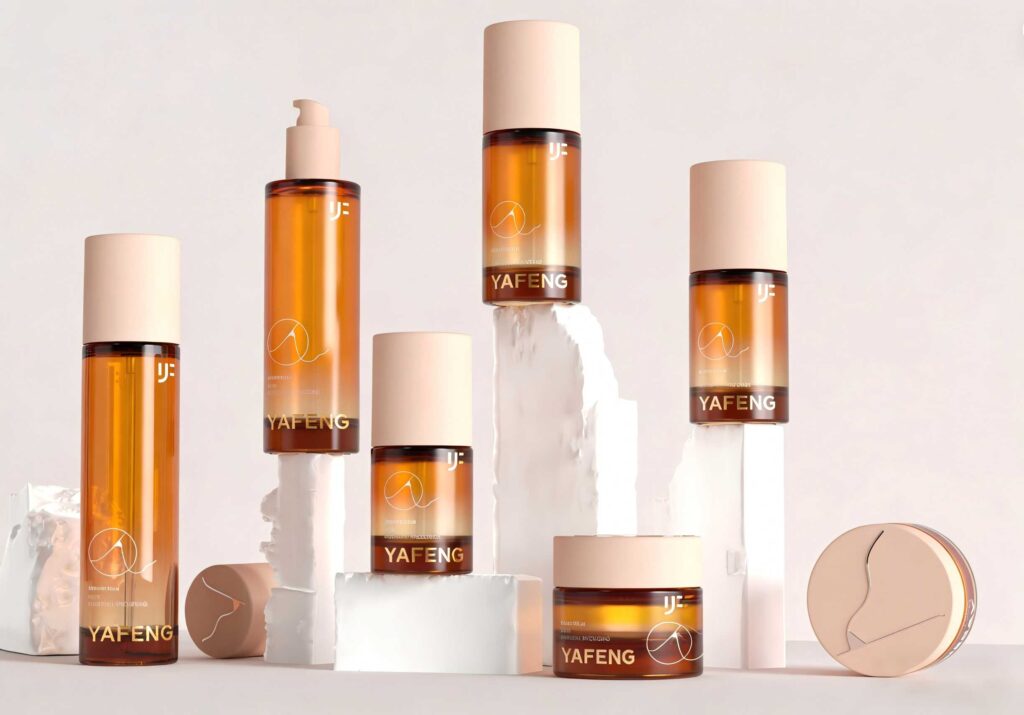
Yafeng Packaging was established in 2004, and has spent more than two decades specializing exclusively in custom glass packaging for perfume and skincare. We do not manufacture generic commodity bottles. Our singular focus on this niche means that every process insight in this article is drawn from real project experience — from hundreds of briefs, thousands of samples, and the relentless refinement that comes from working at the intersection of aesthetic ambition and technical discipline.
Over the past twenty years, Yafeng has served as an OEM manufacturing partner for multiple well-known domestic and international fragrance and skincare brands, with customers across Europe, North America, and Southeast Asia. The reason brands choose — and continue to choose — Yafeng is straightforward:
If you are developing a new fragrance or skincare line and have clear requirements for packaging quality and process standards, we welcome your inquiry. Our team will review your brief and respond with a specific process recommendation and sample quotation. Twenty years of focus. The quality speaks for itself.
Data sources: Yafeng Packaging internal laboratory test records; People’s Republic of China Light Industry Standard QB/T — Cosmetic Glass Bottles (Draft for Comment); GB/T 9286 Cross-Cut Adhesion Test Standard. Reproduction requires attribution.
Odkryj elegancję i trwałość szklanych opakowań na kosmetyki! Dowiedz się, w jaki sposób szklane butelki chronią pielęgnację skóry i dostosowują się do ekologicznych rozwiązań.
Poznaj 11 metod uszlachetniania powierzchni opakowań kosmetycznych, które poprawiają estetykę, trwałość i wizerunek marki. Poznaj ich zalety, wady i zastosowania, aby wybrać najlepszą opcję.
Dowiedz się, czy butelki perfum nadają się do recyklingu i jak pozbywać się ich w sposób zrównoważony. Przewodnik po recyklingu, ponownym użyciu i zmniejszaniu ilości odpadów dla miłośników zapachów!
Poznaj trendy w projektowaniu opakowań kosmetycznych, innowacyjne materiały i zrównoważone rozwiązania, aby ulepszyć swoją markę produktów do pielęgnacji skóry. Przygotuj swoją strategię pakowania na przyszłość!
Odkryj zalety słoików z bursztynowego szkła do pakowania kosmetyków! Dowiedz się, w jaki sposób chronią one Twoje produkty, wzmacniają Twoją markę i oferują zrównoważone rozwiązanie.
Discover why conventional hot stamping fails perfume alcohol tests, which foil types and coatings pass, and how to choose the right process for your fragrance packaging.
Poznaj sitodruk i tłoczenie na gorąco szklanych butelek kosmetycznych, w tym procesy, wady, porównanie kosztów i wskazówki dotyczące wyboru wiarygodnych producentów.
Odkryj, w jaki sposób powlekanie natryskowe ulepsza opakowania kosmetyków do pielęgnacji skóry i perfum, poprawiając wygląd, tożsamość marki, trwałość i bezpieczeństwo dzięki zaawansowanej technologii.
Poznaj niestandardowe i standardowe butelki do opakowań do pielęgnacji skóry. W tym szczegółowym przewodniku dowiesz się, w jaki sposób rozwiązania Yafeng zwiększają tożsamość marki, jakość i wydajność.
Dowiedz się, jak gradientowy kolor w sprayu przekształca szklane butelki kosmetyczne, poprawia wizerunek marki i zwiększa atrakcyjność produktu dzięki spostrzeżeniom ekspertów z Yafeng Packaging.
Odkryj, jak działa aromaterapia rattanowa i dlaczego szklane butelki są najlepszym wyborem ze względu na długotrwały zapach, bezpieczeństwo i zrównoważone, eleganckie opakowanie.